IXPN Deploys Critical Internet Infrastructure to Make Nigerian Websites Faster and More Resilient

The Internet Exchange Point of Nigeria (IXPN) has announced the deployment of new internet infrastructure aimed at significantly improving website loading speeds across Nigeria while strengthening the country’s resilience against cyber disruptions and global network outages.

The announcement was made during the organisation’s 2026 Annual Members Engagement Forum in Lagos, where IXPN executives outlined a strategic push to localise critical components of Nigeria’s internet architecture. At the centre of this upgrade is the deployment of an authoritative Domain Name System (DNS) server within IXPN’s local network; a move expected to reduce latency and enhance stability for millions of internet users.

DNS servers act as the internet’s address book, translating website names into numerical IP addresses that computers use to locate online resources. Until recently, many of these requests from Nigeria were routed to servers located abroad, increasing response times and exposing local connectivity to risks tied to international disruptions. By hosting key DNS infrastructure domestically, IXPN aims to keep more internet traffic within Nigerian borders, reducing delays and improving reliability.

IXPN’s Chief Executive Officer, Muhammed Rudman, described the development as a critical step toward digital sovereignty and operational efficiency. According to him, the newly deployed system is already processing thousands of DNS queries per second, indicating strong adoption and measurable performance improvements across connected networks.

The initiative was executed in collaboration with the Canadian Internet Registration Authority (CIRA), which provided hardware support for the deployment. The partnership ensures that global domain queries can now be resolved more efficiently from within Nigeria’s network ecosystem.

In addition, IXPN confirmed it has entered into a memorandum of understanding with Verisign to host primary DNS infrastructure for major global domains such as .com and .net locally. This arrangement is particularly significant, as it strengthens Nigeria’s ability to maintain access to widely used internet services even during international outages, undersea cable faults, or coordinated cyberattacks targeting overseas infrastructure.

For Nigeria’s growing digital economy, the implications are substantial. Faster DNS resolution translates into quicker website loading times, improved user experiences for streaming and online transactions, and more reliable access for businesses operating in e-commerce, fintech, media, and cloud services. By reducing reliance on foreign upstream providers, the country also lowers exposure to external vulnerabilities that could otherwise disrupt banking systems, government platforms, or critical communications.

Founded in 2006, IXPN operates as a neutral, non-profit interconnection hub that enables internet service providers, mobile network operators, content platforms, and enterprises to exchange traffic locally. Over the years, it has played a central role in keeping domestic internet traffic within Nigeria, cutting bandwidth costs and boosting network efficiency. The latest infrastructure upgrade signals an expansion of that mandate from traffic exchange to deeper control over core internet functions.

As Nigeria continues to position itself as one of Africa’s leading digital markets, investments in resilient infrastructure are becoming increasingly urgent. With cyber threats evolving and data consumption rising rapidly, the ability to localise critical systems is no longer just a technical upgrade, it is a necessity.

Lagos State Introduces 5% Tax on Gaming and Betting Winnings

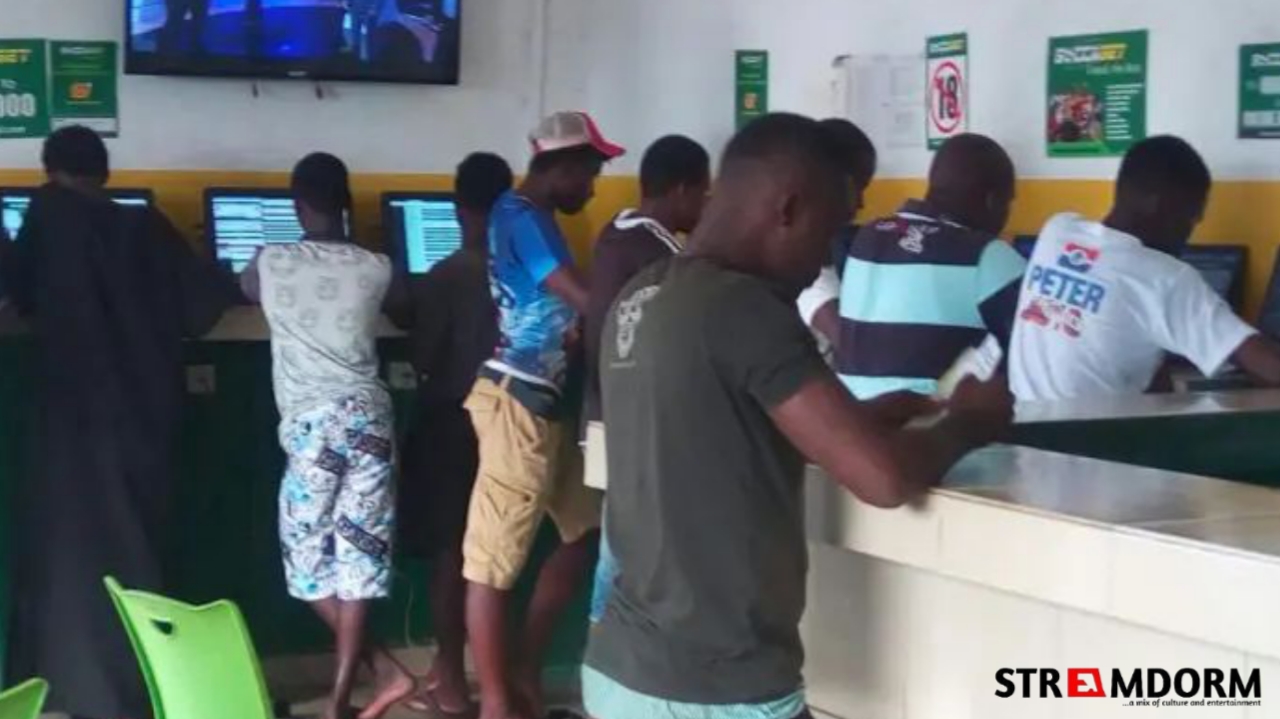
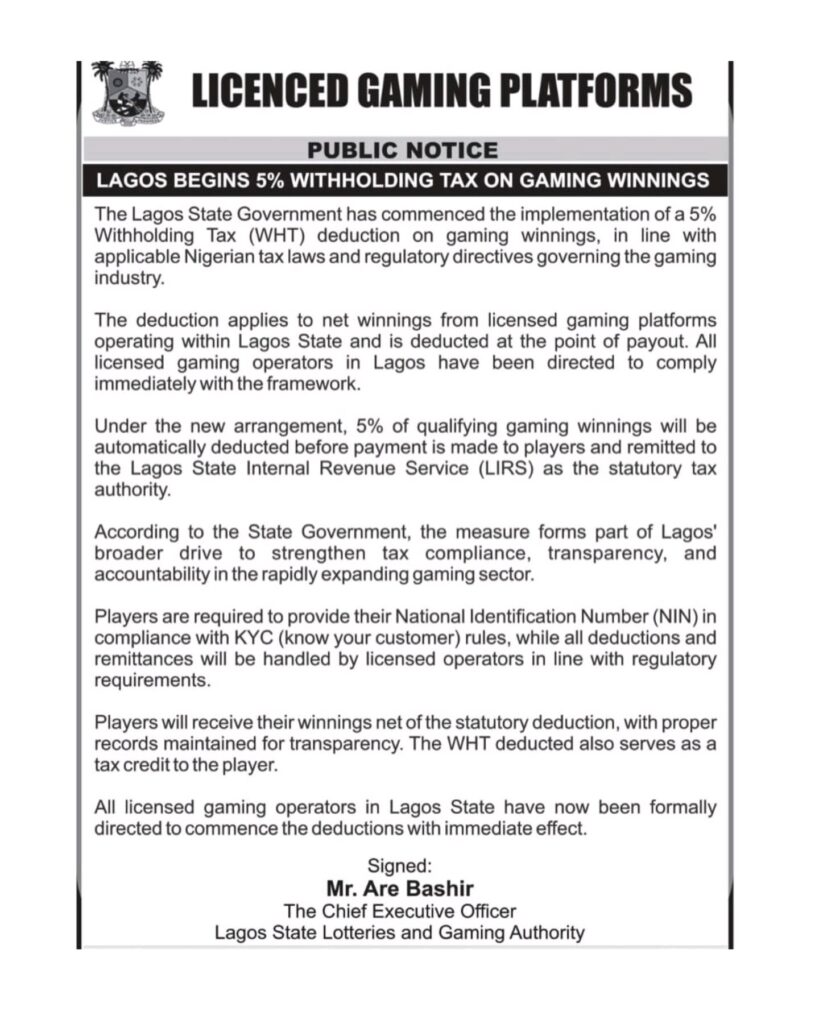
The Lagos State Government has officially begun enforcing a 5% withholding tax on winnings from licensed gaming and betting platforms, marking a major development in Nigeria’s digital gaming sector. The tax is applied to net payouts, meaning players now receive winnings after the deduction.

The move comes as Lagos experiences rapid growth in online sports betting and gaming activities. Millions of bettors participate daily, prompting the government to formalize taxation and ensure the sector contributes fairly to public revenue. The Lagos State Internal Revenue Service (LIRS) has positioned this measure as part of a broader strategy to enhance compliance, transparency, and oversight of digital financial activities.

Under the new rule, licensed operators automatically deduct 5% from all net winnings before payouts. For instance, a bettor who wins ₦100,000 will now receive ₦95,000. Some platforms may also require a National Identification Number (NIN) for identity verification in line with KYC regulations.

The impact is felt across the sector. Licensed operators must update systems to comply with the deduction, while players see reduced payouts but can use the withheld tax as a credit toward personal tax obligations. The government stresses that only licensed operators are affected, leaving unregulated platforms outside the formal tax system.

Industry reactions are mixed. Advocates say the tax formalizes and strengthens the gaming industry, while critics worry it could push bettors toward unlicensed operators. Nevertheless, the Lagos Government maintains that the measure will provide a sustainable revenue stream and improve regulatory oversight.

As Nigeria’s gaming sector continues to grow, the 5% tax highlights Lagos State’s commitment to regulating the industry, ensuring transparency, and capturing revenue from a digital economy that shows no signs of slowing.

Gabon Suspends Facebook, TikTok Nationwide Over Alleged Spread of False Information

Authorities in Gabon have ordered the immediate suspension of major social media platforms across the country, accusing them of spreading false information and harmful content capable of destabilising public order.

The decision was announced on February 17, 2026, by the country’s media regulator, the High Authority for Communication (HAC). In a statement, the regulator said the suspension would remain in place “until further notice.”

Although the order did not publish an exhaustive list of affected platforms, access to Facebook, TikTok, and other widely used social media services was disrupted nationwide shortly after the announcement.

According to the regulator, the decision was taken in response to what it described as the growing circulation of “false information,” defamatory content, hate speech, cyberbullying, and the unauthorised disclosure of personal data online.

The HAC argued that such activities pose a threat to social cohesion, public order, and national stability. Authorities also suggested that existing content moderation efforts by platform owners were insufficient to curb abuses.

Officials maintained that the move does not amount to a violation of freedom of expression, stating that constitutional rights must be exercised within legal limits, particularly when national security and public order are at stake.

The suspension comes amid heightened political and social tension in the country, with recent reports of protests and labour unrest. Observers say governments in several countries have previously imposed similar restrictions during periods of instability, often sparking debate about the balance between security concerns and digital freedoms.

The shutdown is expected to significantly affect communication, small businesses, digital creators, and media outlets that rely on social platforms for outreach and information sharing. Many citizens use social media not only for social interaction but also for commerce, news consumption, and civic engagement.

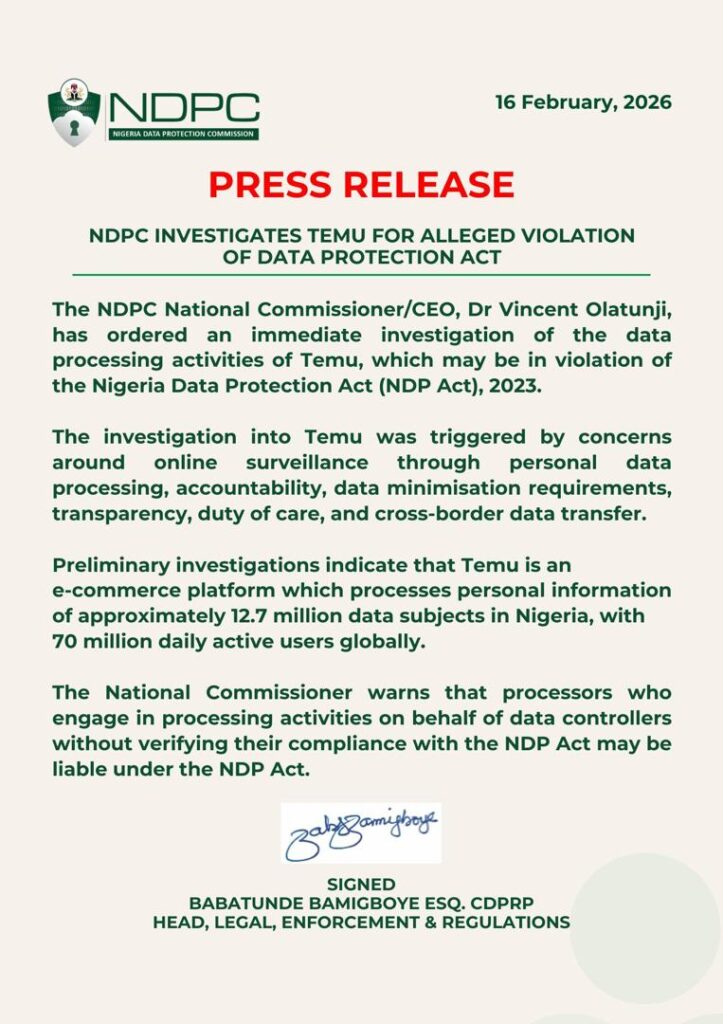
NDPC Probes Temu Over Alleged Data Protection Violations Affecting 12.7 Million Nigerians

Nigeria’s data privacy regulator has launched an investigation into fast-growing e-commerce platform Nigeria Data Protection Commission (NDPC) over alleged violations of the country’s data protection laws.

The commission confirmed that it has opened a formal probe into Temu, following concerns about how the platform collects, processes, and transfers personal data belonging to Nigerian users.

According to the NDPC, the investigation was prompted by concerns that Temu’s data processing practices may not fully align with the provisions of the Nigeria Data Protection Act (NDPA).

The commission is reportedly examining the scale and nature of personal data collection from Nigerian users, including whether the company complies with data minimisation principles and whether it maintains transparency in how user data is processed. Regulators are also reviewing issues surrounding cross-border data transfers and whether appropriate legal safeguards are in place, as well as the platform’s overall accountability and duty of care obligations under Nigerian law.

At the centre of the probe is the question of whether Temu collects more personal data than is necessary for its services and whether users are adequately informed about how their data is being used.

Preliminary reports suggest that Temu processes the personal data of approximately 12.7 million Nigerian users. If confirmed, that would make the case one of the most significant data protection investigations in Nigeria’s digital economy so far.

The scale of the platform’s operations has raised broader questions about how foreign-linked digital marketplaces comply with Nigerian regulatory frameworks, particularly in areas concerning privacy standards and cross-border data handling.

The NDPC’s National Commissioner and Chief Executive Officer, Vincent Olatunji, has consistently maintained that data controllers and processors operating in Nigeria must strictly comply with the NDPA.

Under the law, organisations found in violation of data protection requirements may face administrative penalties, regulatory sanctions, corrective compliance directives, and potential financial fines. The commission has also emphasized that third-party data processors are not exempt from liability and must independently verify compliance.

Since the enactment of the NDPA in 2023, authorities have signaled a more proactive enforcement approach aimed at protecting citizens’ personal data.

As e-commerce adoption grows across Nigeria, scrutiny of how tech platforms manage user data is expected to intensify. The outcome of the Temu investigation could set an important precedent for other multinational digital companies operating in the country.

For now, the NDPC says the investigation is ongoing. Temu has yet to issue a detailed public response regarding the allegations.

We will continue to monitor developments and provide updates as more information becomes available.

X Suffers Global Outage, Thousands Affected Worldwide as Social Media Platform Restores Service

The social media platform X experienced a widespread outage on Monday, leaving thousands of users across multiple countries unable to access the app and website.

Reports of the disruption began surfacing earlier on, with users complaining that their timelines would not refresh, posts would not load, and the platform displayed repeated error messages. In many cases, users encountered the message: “Something went wrong. Try reloading.”

Outage-tracking service Downdetector recorded a sharp spike in complaints from the United States, the United Kingdom, parts of Europe, Asia, and Africa, suggesting the issue was global rather than regional. Users in Nigeria also reported being locked out of the platform during the disruption.

According to reports from Reuters, thousands of outage reports were logged within a short window, indicating a significant service interruption. The exact cause of the outage has not yet been officially disclosed.

This marks another high-profile disruption for X under the ownership of Elon Musk. Since Musk acquired the platform in 2022 and rebranded it from Twitter to X, the company has experienced occasional technical outages, though most have been resolved within hours.

As of the time of filing this report, the app and website appear to be functioning normally again. Users are once more able to refresh feeds, post content, and access their accounts.

While temporary, the outage once again highlights the platform’s central role in global communication and how quickly disruptions are felt across regions when it goes offline.

We will update this story if X releases an official statement explaining the cause of the outage.

Komplett Offers Free GTA 6 to Parents Who Have a Baby on Release Day in Norway

Norwegian electronics retailer Komplett has unveiled one of the most unusual promotional campaigns in gaming history, linking Grand Theft Auto VI (GTA 6) to an extraordinary local offer.

The promotion gives free copies of GTA 6 to parents whose child is born exactly on the game’s confirmed release date: November 19, 2026. Komplett cleverly tied the campaign to the “nine-month” countdown between the promotion launch and the game’s release, playing on the parallel between pregnancy duration and the wait for GTA 6.

As part of the campaign, Komplett rolled out pregnancy-themed billboards and social media posts, featuring lines such as:

GTA 6 drops in 9 months — same as a baby, so if yours arrives that day, the game is on us.”

Dexerto reported that Komplett confirmed the campaign’s legitimacy on Instagram, stating:

This is actually not a joke.”

This promotion has quickly gone viral across social media platforms like Reddit, Instagram, and X, sparking memes and humorous discussions about timing births or planning parental leave around the game’s release.

While the campaign is a retailer-driven initiative and not affiliated with Rockstar Games or Take-Two Interactive, it coincides perfectly with the official GTA 6 release date, confirmed by Take-Two Interactive, ensuring the promotion aligns with the global launch.

This inventive marketing stunt demonstrates how retailers are pushing creative boundaries to generate hype for major releases, capturing attention in local markets while engaging audiences in unexpected ways.

Google AI Tools Begin Blocking Disney Prompts Following Legal Warning

In a move that underscores the escalating battle between generative AI and intellectual property rights, Google has started blocking prompts related to Disney characters across its AI platforms, including its Gemini models. This change comes shortly after The Walt Disney Company issued a legal warning claiming that Google’s AI was producing unauthorized content featuring Disney’s iconic characters.

According to reports, Disney’s legal team argued that Google’s AI tools were capable of generating images, videos, and other content involving characters from franchises like Frozen, Marvel, and Star Wars without permission. The company described this as copyright infringement on a “massive scale,” warning that such content could mislead users and harm Disney’s brand reputation.

Since the warning, Google has adjusted its AI systems. Users attempting to generate content featuring popular Disney characters have reported receiving error messages or refusals from the AI, signaling at least a partial compliance with Disney’s demands. Attempts to generate images of Elsa, Iron Man, or other recognizable Disney and Marvel characters may now be blocked entirely.

While Disney is cracking down on unlicensed AI-generated content, the company is also taking a more collaborative approach with some AI firms. Disney recently struck a multi-million-dollar licensing deal with OpenAI, giving the company official access to Disney characters for AI applications. This contrast highlights a strategic dual approach: protecting intellectual property through legal enforcement while enabling controlled, licensed AI collaborations.

Experts see this development as a key moment in the ongoing debate over AI-generated content and copyright law. The restrictions from Google’s AI tools signal that tech companies may need to adapt their systems to respect intellectual property, while navigating the growing demand for AI creativity.

Google is not alone. Other AI companies, including image generators and character-based AI platforms, have received similar warnings. At the same time. 

Disney Appoints Josh D’Amaro as New CEO, Succeeding Bob Iger

In latest updates, The Walt Disney Company has announced that Josh D’Amaro will take over as its Chief Executive Officer on March 18, 2026. This leadership transition marks the beginning of a new era for the entertainment powerhouse, following the legendary tenure of Bob Iger.

Disney’s decision comes after a thorough succession planning process, signaling the board’s confidence in D’Amaro’s ability to guide the company through an evolving media and entertainment landscape.

Josh D’Amaro has spent nearly 30 years at Disney, climbing the ranks from entry-level roles to become Chairman of Disney Experiences, the division that oversees theme parks, resorts, cruise lines, and merchandise. His leadership has been credited with driving significant growth across Disney’s largest business unit, including major expansions at Disneyland, Walt Disney World, and international parks.

D’Amaro’s operational expertise, particularly in the company’s most profitable segment, positions him to balance Disney’s diverse portfolio; from box office films to Disney+ streaming and immersive experiences.

Bob Iger, whose tenure reshaped Disney through blockbuster acquisitions like Pixar, Marvel, and Lucasfilm, will remain with the company as a senior advisor until his full retirement later this year. Under Iger, Disney became a global entertainment leader, launching Disney+ and cementing its presence in streaming, television, and theme parks.

Alongside D’Amaro’s appointment, Disney named Dana Walden as President and Chief Creative Officer. Walden will oversee Disney’s creative direction across film, television, and streaming content.

This dual leadership approach highlights Disney’s commitment to storytelling and innovation while maintaining operational excellence. It ensures that while Disney expands its parks and experiences, creative content remains at the heart of the brand.

Netflix to End Support on PlayStation 3 from March 2, 2026

Netflix will no longer be available on PlayStation 3.

After nearly two decades of streaming, Netflix is officially saying goodbye to the PlayStation 3. Starting March 2, 2026, the popular streaming app will no longer be accessible on Sony’s eighth-generation console, marking the end of an era for gamers and cord-cutters alike.

PS3 users who try to open Netflix after this date will see a message informing them that the app is no longer supported. The decision follows years of gradual app retirements on older devices, as streaming platforms shift focus to newer hardware that can support updated features, faster streaming, and improved security.

For PlayStation 3 owners, this change is a reminder of the console’s age. Originally released in 2006, the PS3 has outlived many of its contemporaries, maintaining a dedicated fan base that has relied on it for gaming and entertainment. Netflix has not provided an official explanation for the shutdown, but experts suggest that maintaining support for legacy systems is increasingly expensive and technically challenging.

The good news is that Netflix remains available on PlayStation 4, PlayStation 5, smart TVs, and mobile devices, ensuring that users can continue streaming their favorite shows and movies without interruption. For PS3 owners, it may be time to consider upgrading to a newer console or alternative streaming device to maintain uninterrupted access to Netflix.

While this move may disappoint long-time PS3 users, it’s part of a broader trend in the entertainment industry: older hardware is gradually phased out in favor of newer, more capable devices. Netflix has previously retired support on other legacy devices, including certain smart TVs and media players, and the PS3 is now the latest in this list.

For gamers who have relied on the PS3 as their entertainment hub, March 2, 2026, marks the end of a significant chapter. The console will still work for games, but streaming Netflix will no longer be an option. Those looking to continue their binge-watching experience are encouraged to explore alternative platforms that support the service, including PS4, PS5, PCs, and mobile devices.

Ifeyinwa Osime Appointed New Head of the Board at Access Bank

Access Bank Plc has announced the appointment of Ifeyinwa Osime as its new Chairman of the Board, confirming a key leadership transition at one of Nigeria’s most influential financial institutions.

The appointment follows the retirement of Paul Usoro, SAN, who stepped down after completing his regulatory tenure, in line with corporate governance requirements. The development was disclosed by Access Holdings Plc in a formal filing to the Nigerian Exchange Limited.

According to the disclosure, Osime’s appointment forms part of Access Bank’s broader succession and governance strategy, aimed at ensuring continuity at board level while maintaining regulatory compliance.

Group Chairman of Access Holdings, Aigboje Aig-Imoukhuede, described the transition as timely, noting that Osime’s experience and familiarity with the institution would support the bank’s long-term strategic objectives.

Her emergence as Board Chair comes at a period when Nigerian banks are navigating tightening regulations, evolving capital requirements, and increased scrutiny around governance and sustainability.

Ifeyinwa Osime is a seasoned legal practitioner with extensive experience in corporate governance and board oversight. She joined the Access Bank board in November 2019 as an Independent Non-Executive Director, giving her over six years of direct involvement in the bank’s governance structure.

During her time on the board, she chaired several critical committees, including the Board Human Resources and Sustainability Committee and the Board Governance, Nomination and Remuneration Committee; roles that placed her at the centre of leadership development, board evaluation, and succession planning within the institution.

Her committee work is widely viewed as a key factor in her elevation to the board’s highest leadership position.

Ifeyinwa Osime’s appointment signals Access Bank’s continued emphasis on institutional stability and governance continuity, rather than abrupt leadership shifts. As Chairman, she will oversee board strategy, risk oversight, and executive accountability at a time of growing competition within Nigeria’s banking sector and increased regional expansion by the Access brand.

Industry watchers note that her legal and governance background could strengthen board-level decision-making, particularly around compliance, sustainability frameworks, and long-term shareholder value.

With Ifeyinwa Osime now at the helm of the board, Access Bank enters its next phase of leadership with a chairman who combines institutional memory with governance expertise.

Scroll to Top