

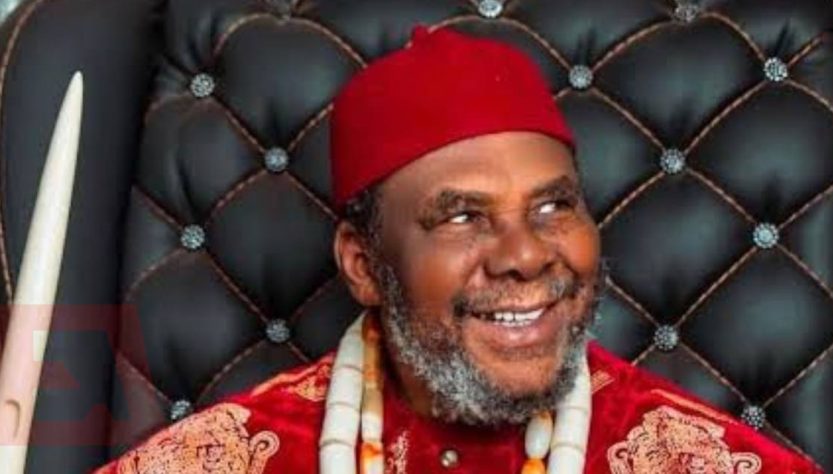
Veteran Nigerian actor and broadcaster Chief Pete Edochie has died at the age of 79, bringing to an end a remarkable career that spanned broadcasting, television, and several decades of Nigerian cinema.
Edochie died at 12:30 a.m. on Wednesday, November 25, 2026, in Enugu, Nigeria, following a prolonged battle with prostate cancer. His death was announced by his son, Chief Leo Pete Edochie, in a statement released on Instagram on behalf of the family.
Titled “An Iroko Has Fallen,” the statement described the deceased as a beloved husband, father, brother and kinsman, identifying him as a retired broadcaster and veteran actor. The family also confirmed that he hailed from Akamnato, Ifite Nteje, Anambra State, and was survived by his wife, Barrister Josephine Edochie, his children, siblings and other relatives. Funeral arrangements are expected to be announced in due course.
Born on March 7, 1947, Pete Edochie, whose full name was Chief Peter Uwadiegwu Ogugua Edochie, was one of the most recognisable figures in Nigerian entertainment. Celebrated for his commanding screen presence, deep voice, memorable delivery of Igbo proverbs and portrayals of traditional rulers and family patriarchs, he became an enduring symbol of authority and cultural identity in Nollywood.
Before becoming one of Nigeria’s most celebrated actors, Edochie established a career in
broadcasting.
Born in Zaria, Kaduna State, to parents from Anambra State, he spent parts of his childhood in different northern Nigerian cities, including Makurdi and Kano, as his father worked with the Nigerian Railway Corporation.
He attended St. Patrick’s and St. James Primary Schools in Zaria before proceeding to St. John’s College in Kaduna. He later studied journalism and television at the School of Journalism and Television in England and received professional training at the British Broadcasting Corporation (BBC).
Edochie began his broadcasting career in February 1967, joining the Eastern Nigerian Broadcasting Corporation as a junior programmes assistant. He gradually rose through the ranks at the organisation, which later became the Anambra Broadcasting Service (ABS), serving as Director of Programmes and Deputy Managing Director and occasionally acting as Managing Director.
During his broadcasting years, he also presented a classical music programme titled Music from the Masters. His career in the industry included an involvement with the Voice of Biafra during the Nigerian Civil War.
His broadcasting experience laid the foundation for his eventual transition into acting, although it was a particular television production that would change the course of his career.
Edochie’s breakthrough as an actor came through his portrayal of Okonkwo in the Nigerian Television Authority’s adaptation of Chinua Achebe’s acclaimed novel, Things Fall Apart.
Released in 1987, the television adaptation introduced his performance to a much wider audience and established him as one of Nigeria’s leading screen actors.
His portrayal of the respected but deeply troubled Igbo warrior was widely acclaimed, earning him national and international recognition. The performance also attracted the attention of the BBC, which sent a delegation to Nigeria to interview him about his interpretation of the character.
Okonkwo became the defining role of Edochie’s career, with generations of viewers associating him with the character and his commanding portrayal of traditional Igbo authority.
The role also demonstrated his ability to translate cultural expressions, traditional values and complex human emotions into compelling screen performances.
Following the success of Things Fall Apart, Edochie became a prominent figure in Nigeria’s emerging film industry, appearing in hundreds of movies and television productions.
He became particularly associated with roles involving traditional rulers, wealthy businessmen, fathers, community leaders and influential patriarchs. His deep voice, measured delivery and frequent use of proverbs became distinctive features of his performances.
Among his notable film appearances are Rituals (1997), Igodo (1999), Billionaire’s Club (2003), Egg of Life (2003), Idemili (2014) and Lionheart (2018).
In Genevieve Nnaji’s directorial debut, Lionheart, Edochie played Chief Ernest Obiagu, featuring alongside Nnaji, Nkem Owoh and other established Nigerian actors. The film became the first Nigerian original film acquired by Netflix, introducing another generation of international viewers to his work.
His filmography also includes Unroyal (2020) and numerous other productions spanning the 1990s through the 2020s.
Across different generations of Nigerian filmmaking, Edochie maintained a recognisable screen identity, becoming one of the industry’s most enduring veteran performers.
Away from the screen, Edochie was married to Barrister Josephine Edochie, a lawyer and former broadcaster whom he met during his years in the industry.
The couple married on March 19, 1969, at St. Finbarr’s Catholic Church in Umuahia, Abia State. Their marriage lasted more than 57 years, and they had six children together.
Among their children are Nollywood actors Yul Edochie and Linc Edochie, while Leo Pete Edochie, who announced his father’s death, is also one of his sons.
Edochie’s family occasionally attracted public attention, particularly in recent years following controversies surrounding Yul Edochie’s marriage to actress Judy Austin and the resulting public disagreements involving his first wife, May Edochie.
Despite the attention, the veteran actor maintained a relatively private family life and was known to be protective of his children.
He is survived by his wife, children, siblings and other relatives.
Edochie’s contributions to Nigerian entertainment earned him several honours during his lifetime.
In 2003, he received the national honour of Member of the Order of the Niger (MON), conferred by former President Olusegun Obasanjo.
He also received the Industry Merit Award at the Africa Magic Viewers’ Choice Awards (AMVCA), a Lifetime Achievement Award from the Africa Film Academy and the African Film Legend Award at the African Film Festival in 2020.
Beyond individual recognitions, his influence extended to the representation of Nigerian and Igbo culture in African cinema, particularly through his memorable performances and decades of work across television and film.
In the months preceding his death, Edochie had spoken publicly about experiencing health challenges.
During a visit to Ghana in October 2026, where he attended engagements connected to the Pete Edochie Legacy Project, the actor disclosed that he was not in good health. He also spoke about experiencing difficulty walking and other physical challenges.
His comments came during a visit to fellow Ghanaian actor Emmanuel Armah, who had also been battling health challenges.
Pete Edochie’s death represents the loss of one of the defining figures of Nigerian screen entertainment.
His passing also comes in the wake of the death of fellow Nollywood veteran Olu Jacobs in September 2026, marking another significant loss for an industry shaped by their generation.
For many viewers, Pete Edochie will forever be remembered as Okonkwo, the character that introduced him to a wider audience and established his place in African television history.
At 79, he leaves behind a body of work that continues to reflect his contribution to Nigerian entertainment and the wider African film industry.
Chief Peter Uwadiegwu Ogugua Edochie (MON), March 7, 1947 – November 25, 2026.
