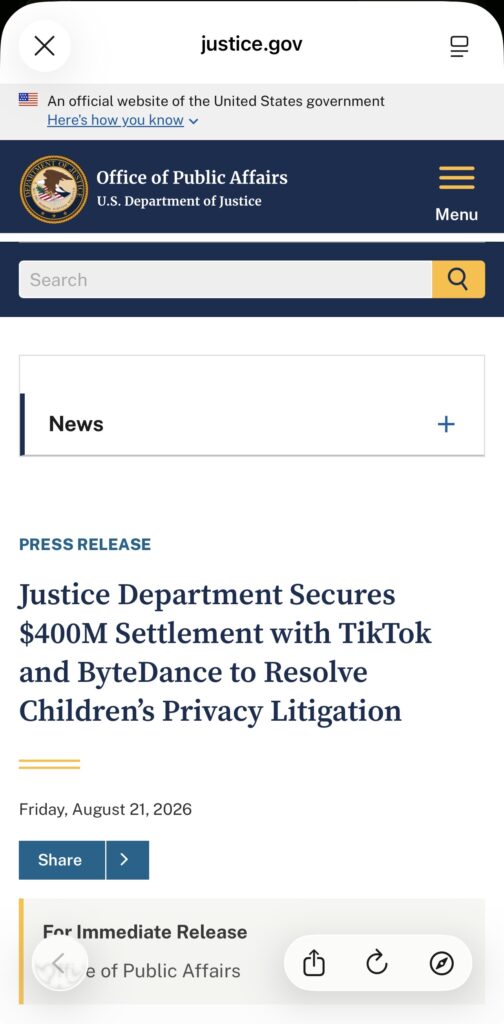
TikTok and its parent company, ByteDance, have agreed to pay $400 million to resolve a U.S. Justice Department lawsuit alleging that the platform violated federal children’s privacy protections by collecting and retaining personal information from users under 13 without the required parental consent.
The settlement, announced by the U.S. Department of Justice on Friday, August 21, is described by the department as one of the largest recoveries ever obtained in a case involving the Children’s Online Privacy Protection Act (COPPA).
The lawsuit stems from a 2024 complaint filed by the Justice Department on behalf of the Federal Trade Commission (FTC) against TikTok, ByteDance and affiliated companies.
The government alleged that TikTok knowingly allowed millions of children under 13 to use the platform despite its minimum age requirement, and that the company collected and used their personal information without first providing the required notice to parents or obtaining verifiable parental consent.
The allegations went beyond ordinary TikTok accounts. Federal regulators also accused the company of collecting children’s information through TikTok’s Kids Mode, a version of the service designed with younger users in mind.
According to the FTC’s complaint, TikTok collected information about children’s activities on the platform and persistent identifiers that could be used to build profiles. The complaint also alleged that some information from Kids Mode users was shared with third parties, including Facebook and marketing analytics company AppsFlyer, for a practice TikTok called “retargeting less active users.”
The FTC further alleged that TikTok had difficulty identifying and removing underage accounts and that parents often faced unnecessary hurdles when trying to have their children’s accounts and data deleted.
One of the more significant allegations in the 2024 complaint concerned accounts TikTok classified as “age unknown.”
The FTC alleged that children could bypass TikTok’s age gate by using credentials from third-party services such as Google and Instagram, allowing them to create accounts without providing their age or obtaining parental consent. According to the complaint, these “age unknown” accounts eventually numbered in the millions.
The FTC complaint also alleged that between February 2019 and July 2022, TikTok collected more than 300,000 problem reports from Kids Mode users that contained children’s email addresses and retained those addresses longer than reasonably necessary.
The settlement is structured in two parts.
$300 million will be paid immediately.
The remaining $100 million will be paid after a court enters an order vacating a previous consent decree involving TikTok’s predecessor, Musical.ly.
That earlier matter dates back to 2019, when Musical.ly agreed to a settlement with the FTC over allegations that it had collected personal information from children under 13 without obtaining the required parental consent.
The company agreed to pay $5.7 million at the time.
TikTok acquired Musical.ly in 2017 and subsequently integrated the service into TikTok.
The Justice Department said TikTok has undergone significant changes to its ownership, management, compliance operations and privacy practices since the 2024 lawsuit was filed.
The department specifically pointed to measures intended to strengthen safeguards for younger users, improve age-related controls and increase parental oversight.
Recent reporting also indicates that TikTok’s U.S. operation has strengthened its age-assurance systems, requires users to provide their birth dates when creating accounts and has employees trained to identify and remove users believed to be under 13.
The Justice Department said these changes contributed to its decision to resolve the case rather than continue with prolonged litigation.
Despite the size of the settlement, it is important to note that the settlement is not a judicial finding that TikTok or ByteDance violated the law.
The Justice Department explicitly stated that the claims resolved by the settlement are allegations only and that there has been no determination of liability.
The agreement allows the government to secure a substantial financial recovery while bringing the 2024 litigation to an end.
Note: This report is based on filings and statements from the U.S. Department of Justice and Federal Trade Commission, alongside corroborating reporting from Reuters and other major outlets. The allegations described above were not judicially determined as part of the settlement.