

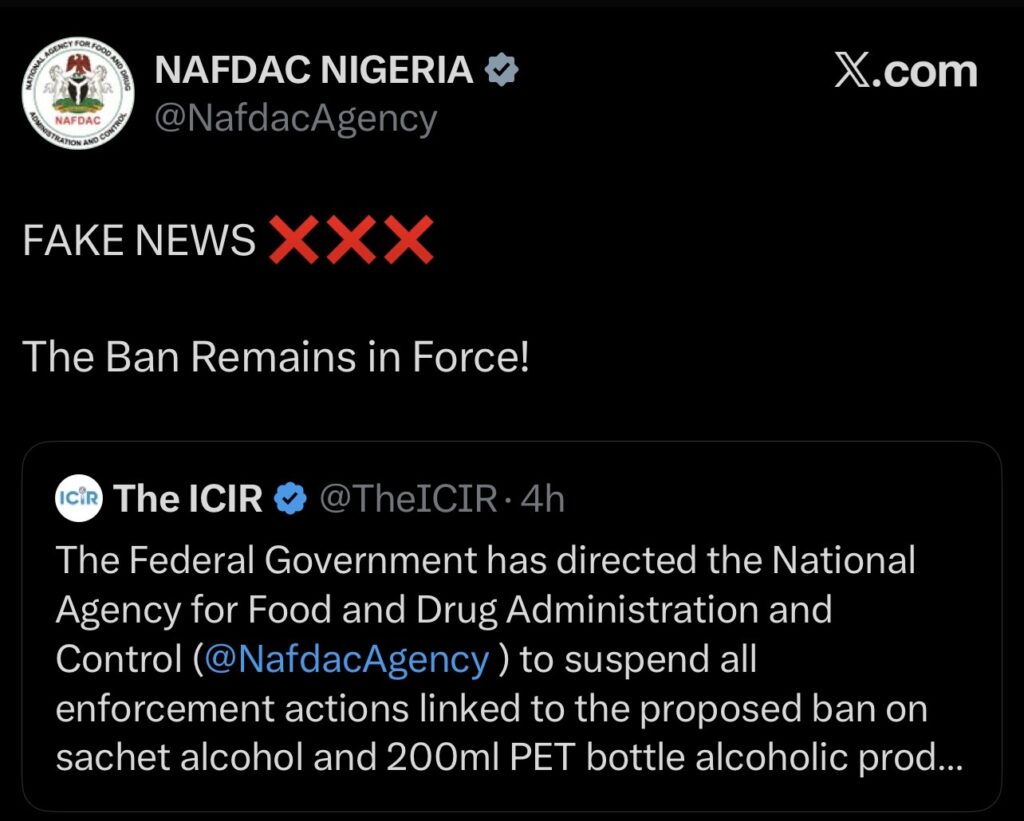
Just hours after reports circulated claiming the Federal Government had directed a pause on the sachet alcohol ban, the National Agency for Food and Drug Administration and Control (NAFDAC) has pushed back strongly, insisting that no such directive has been officially communicated and that the policy remains in force.
In a public statement released Wednesday, NAFDAC described the suspension claims as “false and misleading,” clarifying that it has not received any formal order instructing it to stop enforcement of regulations affecting alcohol sold in sachets and small-volume containers, including 200ml PET bottles.
The agency’s response comes amid growing confusion following earlier reports suggesting that federal authorities had asked regulators to suspend enforcement while broader consultations and policy reviews were underway. NAFDAC’s latest position introduces a direct contradiction, highlighting a widening gap between media reports and the agency’s official stance.
According to NAFDAC, any change in enforcement procedures would be communicated through formal government channels and verified agency platforms. Until then, regulatory activities will continue under existing laws and approved policy frameworks.
The sachet alcohol ban has remained one of Nigeria’s most contentious regulatory issues in recent years. Public health advocates have backed strict enforcement, arguing that cheap, widely accessible alcohol contributes to addiction risks, youth consumption, and broader social harm.
Industry stakeholders and labour groups, however, have warned that abrupt enforcement could threaten thousands of jobs and destabilise supply chains in the beverage and retail sectors. The debate intensified after enforcement actions reportedly affected factories and distribution networks in early 2026.
The disagreement over whether enforcement has been suspended also raises broader questions about communication and authority within Nigeria’s regulatory structure. Civil society organisations have already initiated legal challenges around government involvement in enforcement decisions, arguing that regulatory agencies must operate within clearly defined statutory boundaries.
As conflicting narratives continue to circulate, industry players, retailers, and consumers are left navigating uncertainty over compliance and future policy direction.
Earlier Reports