
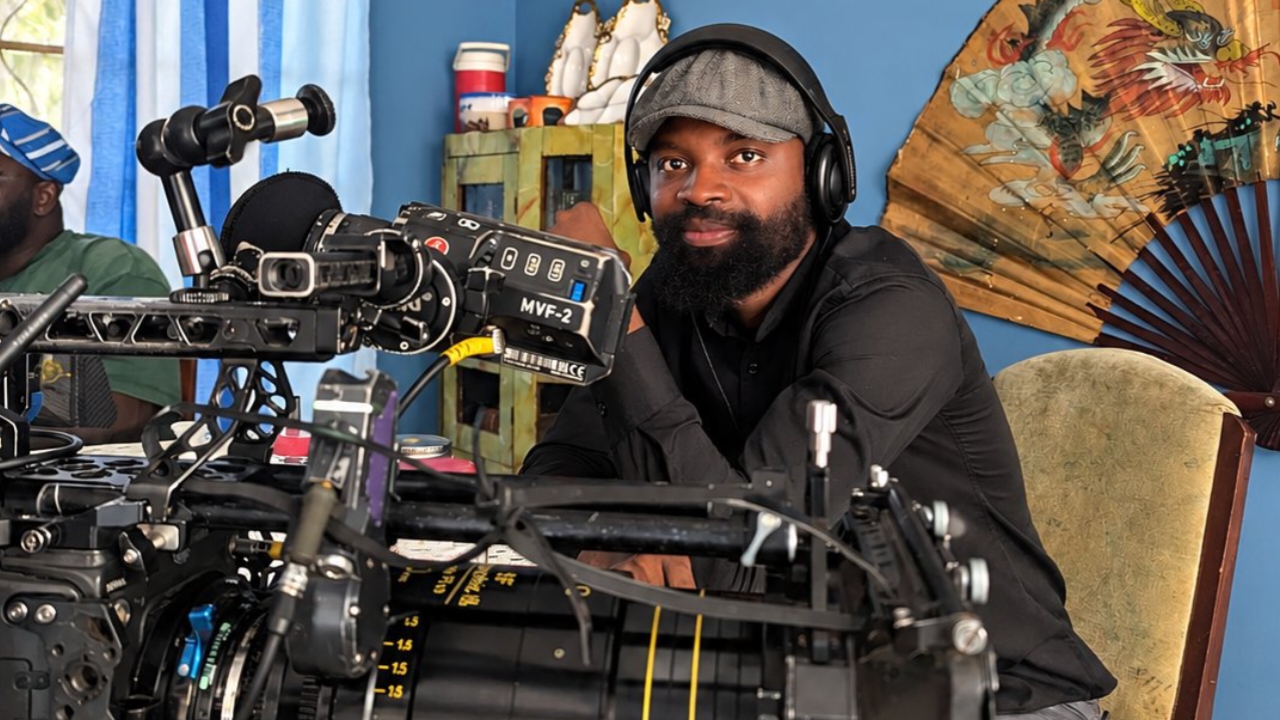
Nollywood, the umbrella term for the Nigerian film industry, produces thousands of movies yearly across incredible genres and sub-genres. Since inception, we have had talents whose projects make us, the audience, question and address societal issues, such as Taiwo Egunjobi. Taiwo Egunjobi is a talented writer and filmmaker whose filmography questions social and systemic issues.
Growing up, film became a part of who Taiwo Egunjobi is today: “I grew up in a family, uh, where films were watched as a family practice. You, you would sit down to watch films.” You see, Taiwo Egunjobi’s father was a well-travelled professor who had a hobby of collecting movies around the world; his family would sit to watch classics like ‘The Sound of Music (1965)’, ‘Doctor Zhivago (1965)’, ‘Sarafina (1992)’, and ‘Police Academy (1984)’. “I learned later that he used to run a cinema, you know. He co-owned a cinema in, some time of his life with a Friend…and that was in combination with my mom, who used to watch a lot of Nigerian films.”
Growing up in such an incredible household, Taiwo Egunjobi would later go on to study psychology at the University of Ibadan; this would help give him “ a larger appreciation of human behaviour and how it is shaped and what shapes it, how nature and nurture affect us…how…we can study human behaviour and measure it”. Drawn to film and cinema, his understanding of psychology helps him understand characters and people, which later proved invaluable to his creative pursuits.
Taiwo Egunjobi also grew up with legendary filmmakers like Tunde Kelani, Tade Ogidan, and Femi Odugbemi, whom he also studied and who have inspired his work. He has also studied global names like Asghar Farhadi, [Quentin] Tarantino, [Martin] Scorsese, [Francis Ford] Coppola, [Yasujirō] Ozu, [Abbas] Kiarostami, and [Andrei] Tarkovsky: “…I studied all these guys. And what I was learning was that… I had particular visual interests and ultimately had some thematic things that resonated with me, and I wanted my films to do those things. And so I started making films.”
Since working on his 2013 30-minute short film ‘Blades of Ennui’ to ‘All Na Vibes (2021)’, “I finally understood what I wanted my films to be about. I knew at that point in time that I couldn’t make a film that wasn’t going to be a commentary or shine a torch on my society and behaviour. It just wasn’t possible.”
Taiwo Egunjobi questions everything, from people to society, race to government, philosophy to purpose, and responsibility to cultural preservation: “I question things people say. I question what people say are the reasons for why we are where we are. And that has led me to make the films I make.”
Speaking on whether Nigerian films have done enough to address stolen cultural heritage, “I don’t think Nigerian film has done a lot to address cultural theft. I don’t think this topic represents a dominant thematic occupation of Nigeria. Of course, there have been films around it. I wouldn’t say I’m the only filmmaker who has attempted it, but yes, it’s not an occupation for most people because I don’t imagine it’s an interesting topic for many filmmakers want to be about. The people I watch and people I follow, the people that trained me, make films about things of this nature, in documentary, in essays and in films.”
Taiwo Egunjobi told Streamdorm, “Fire and the Moth was not supposed to be… I didn’t intend it to be an essay of any type. I just wanted to make a film that would be exciting, would be serious, and will be, uh, artistically sound and thematically resonant, you know. And I wanted to make that film. I had, for the longest period, been thinking about cultural preservation and artifacts. I’d also been very fascinated with the neo-Western film genre… And again, I was also being inspired by the stories of smugglers and all of those things. Not inspired, but interested. And, you know, a time comes when you are talking with your co-writer, with Isaac Ayodeji, and these ideas begin to form together.”
Taiwo Egunjobi revealed to us that there was a discussion alongside film producer Olakunle Martini Akande to make a short film with the same plot: “We’ve always had these ideas speculating. And I think for me, the interesting part of it was, uh, we wanted not to just talk about how our cultural artifacts were taken, but also about local complicity and how our complicity, whether active or inactive, is part of the narrative and it’s something we should be thinking about and talking about.”
Taiwo Egunjobi told Streamdorm that his long-awaited documentary is ready and was supposed to be released this year, but “I still have no information about when it’s going to be released”. Also, his four-part crime drama series, Bodija, is set to release this December.