
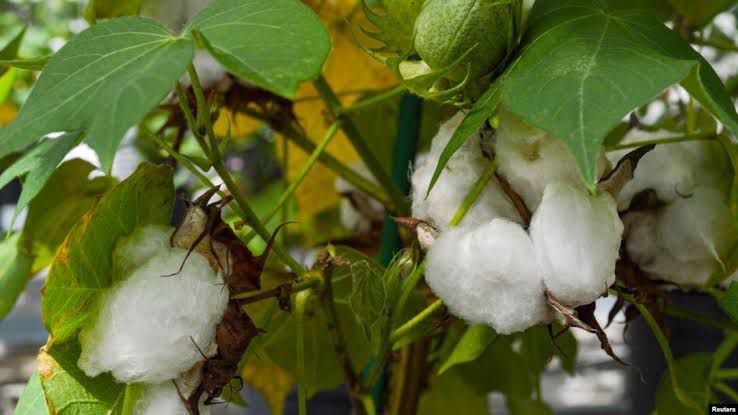
Nigeria’s Federal Government has pushed ahead with the rollout of genetically modified (GM) cotton seeds, launching two new varieties; Mahyco C567 BGII and Mahyco C571 BGII despite lingering backlash and the mixed performance of earlier GMO cotton initiatives.
The move signals a renewed commitment to biotechnology as a solution to Nigeria’s struggling cotton and textile industry, even as farmers, civil society groups and environmental advocates continue to question its long-term impact.
The new GM cotton varieties were unveiled through the National Agricultural Seeds Council (NASC) in partnership with Mahyco Nigeria. According to officials, both Mahyco C567 BGII and C571 BGII are engineered with Bt (Bacillus thuringiensis) technology, designed to protect cotton plants against bollworm infestations, one of the crop’s most destructive pests.
Government representatives say the seeds are capable of delivering significantly higher yields, estimating production levels of 3.5 to 4.4 tonnes per hectare, compared to Nigeria’s current average of under 1.5 tonnes per hectare using conventional cotton varieties.
Other promised benefits include:
- Reduced pesticide use
- Lower production costs
- Improved fibre quality for textile manufacturing
Officials argue that widespread adoption could help revive dormant ginneries, support local textile mills and create jobs across the cotton value chain.
Nigeria’s renewed push for GM cotton comes against the backdrop of earlier GMO trials that failed to meet expectations.
In 2018, Nigeria approved commercial cultivation of Bt cotton, also developed by Mahyco. At the time, the seeds were promoted as a breakthrough that would transform cotton farming. However, several years later, industry stakeholders reported that yields remained low and that farmers saw limited economic improvement.
Critics argue that the government’s current approach risks repeating past mistakes by focusing heavily on seed technology while ignoring structural problems.
Beyond performance issues, the new GM cotton rollout has reignited broader debates around genetically modified organisms in Nigeria.
Civil society organisations and environmental groups have raised concerns about: Farmer dependence on proprietary seeds that cannot be replanted, Long-term environmental and biodiversity risks, Transparency in biosafety approvals and Insufficient independent impact assessments.
Some advocacy groups have called on lawmakers to suspend or restrict GMO approvals until stronger regulatory safeguards and long-term studies are made public.
The government, however, maintains that the seeds have passed biosafety reviews and insists that biotechnology is essential to achieving food security and agricultural competitiveness.
Nigeria once had a thriving cotton sector that supported a robust textile industry. Today, most textile mills operate far below capacity, while cotton production remains fragmented and underfunded.
The introduction of Mahyco C567 BGII and C571 BGII represents another attempt to reverse that decline. Whether these new varieties will deliver better results than earlier GMO cotton and whether farmers will see sustainable gains remains uncertain.
For now, Nigeria’s cotton revival strategy rests once again on genetically modified seeds, even as the debate over their effectiveness, safety and long-term impact continues.