
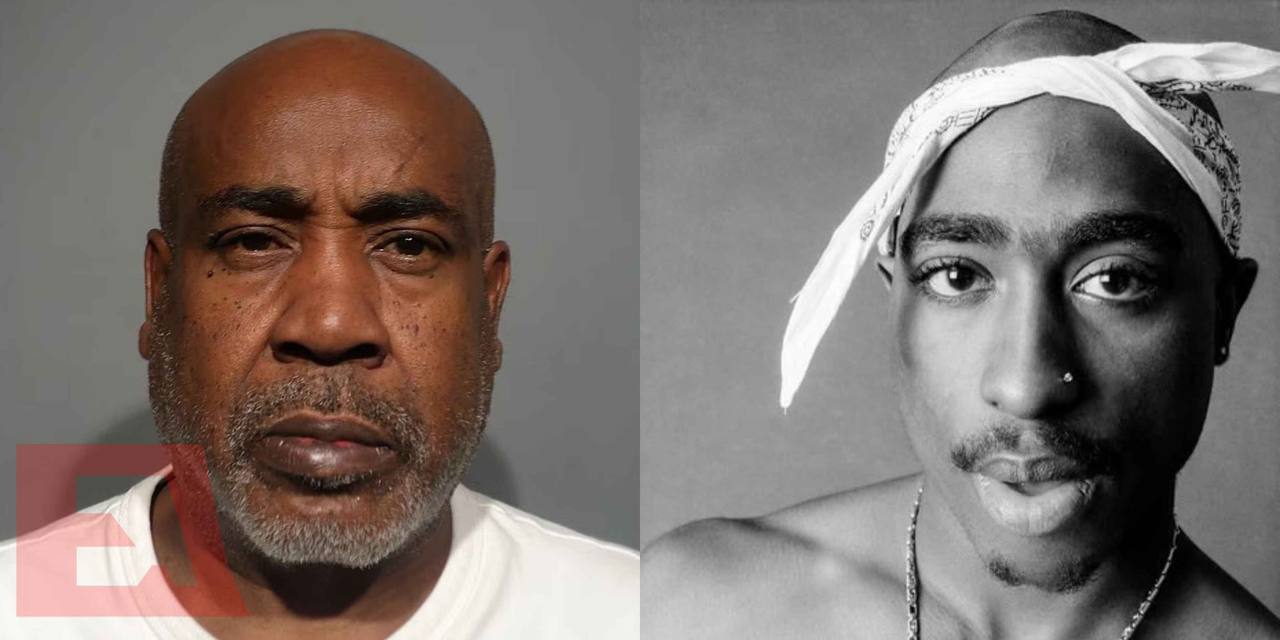
Duane “Keffe D” Davis has been sentenced to 40 years to life in prison for his role in the 1996 murder of legendary rapper Tupac Shakur, marking a major development in one of hip-hop’s most notorious criminal cases.
Davis, 63, was sentenced on Tuesday, October 13, 2026, in a Las Vegas courtroom, nearly two months after a jury found him guilty of first-degree murder for orchestrating the fatal shooting that claimed Shakur’s life at the age of 25.
Judge Carli Kierny handed Davis a sentence of 20 years to life for first-degree murder, followed by a consecutive 20-year sentence associated with the use of a deadly weapon, bringing the total sentence to 40 years to life.
During the hearing, Judge Kierny addressed the gravity of the crime and the impact of Shakur’s death on his family.
“You don’t get to take a man from his family,” Judge Kierny said. “You don’t get to take his very life, his whole future, from him and just walk away from it. Especially when that man is Tupac Shakur.”
The sentence means Davis could spend the remainder of his life in prison. Although he could eventually become eligible for parole, release is not automatic, and his legal team has indicated that it intends to appeal his conviction.
Tupac Shakur was shot on September 7, 1996, while riding in a black BMW driven by Marion “Suge” Knight, the co-founder of Death Row Records, in Las Vegas.
The shooting occurred after a heavyweight boxing match between Mike Tyson and Bruce Seldon at the MGM Grand casino. Earlier that evening, Shakur and members of his entourage had been involved in a physical altercation with Orlando Anderson, Davis’s nephew.
The confrontation was linked to longstanding tensions between rival street gangs in California.
According to prosecutors, the casino fight prompted Davis and his associates to seek revenge against Shakur and his entourage. Later that night, a white Cadillac pulled alongside the BMW near the Las Vegas Strip, and gunfire erupted.
Shakur was struck multiple times. Knight survived the attack, but the rapper died from his injuries six days later, on September 13, 1996.
He was 25 years old.
His death sent shockwaves through the music industry and left one of hip-hop’s most influential artists unable to fulfil the enormous creative potential that had made him a global figure.
For nearly three decades, the murder remained unsolved, becoming one of the most widely discussed cases in music history.
Prosecutors argued that Davis helped organise the attack, supplied the firearm and was inside the Cadillac from which the shots were fired.
They maintained that he played a leading role in the retaliation following the confrontation involving his nephew, even though he was not accused of personally firing the fatal shots.
Davis became the central figure in the investigation after making statements about his involvement in the shooting over several years.
His accounts appeared in interviews, media appearances and his 2019 memoir, Compton Street Legend. He also discussed the incident during a 2008 interview with investigators under an agreement connected to a separate investigation.
Prosecutors argued that Davis’s own words helped establish his involvement and provided investigators with information they could corroborate.
His public statements eventually helped revive an investigation that had stalled for years.
Davis was arrested in September 2023 and charged with murder in connection with Shakur’s death. He was the only person ever charged in the case.
Davis pleaded not guilty and disputed the prosecution’s account of his role in the murder.
His defence team argued that his previous statements were not necessarily reliable and that he had exaggerated aspects of the story. They also challenged the lack of physical evidence directly connecting him to the shooting, including the absence of the murder weapon.
Prosecutors, however, argued that Davis’s accounts, alongside other evidence presented at trial, established his responsibility for orchestrating the attack.
After hearing the evidence, a jury found Davis guilty of first-degree murder on August 31, 2026, following a trial that lasted several weeks. The jury reached its verdict after less than three hours of deliberation.
The conviction made Davis the first and only person to be found guilty in connection with Shakur’s murder.
Orlando Anderson, Davis’s nephew, was identified during the investigation as a possible gunman because of the confrontation with Shakur earlier on the night of the shooting.
Anderson was questioned by police but was never charged in connection with the rapper’s murder. He died in a separate shooting in 1998, two years after Shakur’s death.
Prosecutors argued that the earlier altercation involving Anderson provided the motive for the attack later that night.
However, the identities of the people who fired the fatal shots have not been conclusively established through the case.
Davis’s conviction was based on his alleged role in organising the murder, rather than an allegation that he personally pulled the trigger.
Davis’s sentence consists of consecutive terms, meaning the second term follows the first rather than running at the same time.
In practical terms, he faces a minimum prison term of 40 years before potentially becoming eligible for parole, subject to the applicable legal calculations and rules.
Davis was born in June 1963 and is 63 years old. Serving the full 40-year minimum would put him at approximately 103 years old before completing that period, although credit for time already served may affect the calculation.
According to reporting on the sentencing, Davis received credit for 731 days already served.
Even when an inmate becomes eligible for parole, release is not guaranteed. If parole is denied, Davis could remain in prison for the rest of his life.
The sentence therefore leaves open the possibility of release while placing Davis at risk of dying behind bars.
Tupac Shakur’s murder has remained a defining tragedy in hip-hop history, attracting years of speculation, documentaries, books and investigations.
The rapper was celebrated for his music, his screen performances and his ability to address social inequality, violence and life in marginalised communities. His influence has endured long after his death, with his catalogue continuing to reach new generations of listeners.